
India 48, Bangladesh 25 — The Real Story Sits on the Bonus Line
**মূল উত্তর** এশিয়ান Games ২০২৬-এর গ্রুপ পর্বে ভারত পুরুষ কাবাডি দল বাংলাদেশকে ৪৮–২৫-এ হারায়, বিরতিতে এগিয়ে ছিল ২৯–৯, এবং চল্লিশ মিনিটে তিনটি অল আউট পায়। ম্যাচের সবচেয়ে উল্লেখযোগ্য সংখ্যা হলো বাংলাদেশের ২৫ পয়েন্টের প্রায় ১১টি (৪৪ শতাংশ) বোনাস লাইন থেকে আসা। **মূল তথ্য** - ভারত ৪৮, বাংলাদেশ ২৫; প্রথমার্ধে ভারত এগিয়ে ছিল ২৯–৯ (Khel Now রিপোর্ট)। - ভারত চল্লিশ মিনিটে তিনটি অল আউট পায়, নিজে একবারও অল আউট হয়নি। - দ্বিতীয়ার্ধে ভারতের পয়েন্ট ২৯ থেকে ১৯-এ নামে, বাংলাদেশের ৯ থেকে ১৬-তে ওঠে। - অর্জুন দেশওয়াল দ্বিতীয়ার্ধের শুরুতে দেবাঙ্ক দলালের বদলে নামেন। - ভারত ২৪ সেপ্টেম্বর ২০২৬ সকাল ০৯:৪৫-এ চাইনিজ তাইপের মুখোমুখি হবে, যা গ্রুপ A-এর শেষ ম্যাচ। **সূত্র উল্লেখ** মূল সূত্র: Khel Now (ভারতীয় ক্রীড়া সংবাদ পোর্টাল), ম্যাচ প্রতিবেদন, সেপ্টেম্বর ২০২৬। এই ম্যাচের সব তথ্য একটিমাত্র প্রতিবেদন থেকে নেওয়া; স্বাধীনভাবে যাচাই করা হয়নি, তাই অফিসিয়াল স্কোরশিটের সঙ্গে মিলিয়ে দেখা প্রয়োজন। **সম্ভাব্য অনুসরণীয় প্রশ্ন** প্রশ্ন: ভারতের প্রতিরক্ষার আসল দুর্বলতা কী? উত্তর: বোনাস লাইন নিয়ন্ত্রণ — বাংলাদেশ টাচ ছাড়াই প্রায় ১১ পয়েন্ট নিয়েছে, যা কর্নার-কভার Positionের ইঙ্গিত দেয়। প্রশ্ন: ভারতের নবম স্বর্ণের পথে বাধা কে? উত্তর: ইরান, কারণ ২০১৮ সালে ইরানই ভারতের এশিয়ান Games আধিপত্য ভেঙেছিল এবং নকআউটে তারাই সবচেয়ে কঠিন প্রতিপক্ষ। প্রশ্ন: চাইনিজ তাইপের বিরুদ্ধে ম্যাচটি কতটা গুরুত্বপূর্ণ? উত্তর: ফলাফলের দিক থেকে গুরুত্বহীন, কিন্তু সেমিফাইনালের আগে কর্নার-কভার জুটি পরীক্ষার একমাত্র পূর্ণ সুযোগ।
At half-time the board read 29–9. In a Delhi WhatsApp group of over 120 kabaddi watchers, several were already typing, “Bangladesh won’t cross 40.” I opened my notebook and wrote the opposite question. Seven of India’s 29 points had come off the bonus line; three of Bangladesh’s nine had come the same way. So which was true — that India’s defence was shutting down contact, or that it was handing over the space behind the baulk line?
Full time: 48–25. India’s second half produced 19. Bangladesh produced 16, eight of them from the bonus line. Across the match, roughly 11 of Bangladesh’s 25 points — around 44 percent — came from the bonus line alone. Nobody in the celebratory coverage looked there. But that is exactly the number a knockout opponent will look at.

Context: a sport where getting caught is the point
For first-time viewers, kabaddi in one line: seven against seven on a court roughly 13 metres by 10, and every attack — a raid — must be completed inside 30 seconds. The raider chants “kabaddi, kabaddi” from entry to exit, because the chant is the proof he is not inhaling. Break the chant and the raid is void. Touch a defender and return home safely, and the point is his. But if the defenders stop him inside their own half, the point is theirs. A bonus line sits one metre behind the defenders’ baulk line; cross it while the defending side has six or more players on court and the raider earns a point without touching anyone.
Add three more rules. All Out: dismiss all seven of the opposition and you score two points while the entire dismissed side revives. Super Tackle: a tackle made with three or fewer defenders on court is worth two instead of one. Super Raid: three or more points from a single raid. Matches run in two 20-minute halves. This is the Standard Style the Asian Games and the Pro Kabaddi League use.
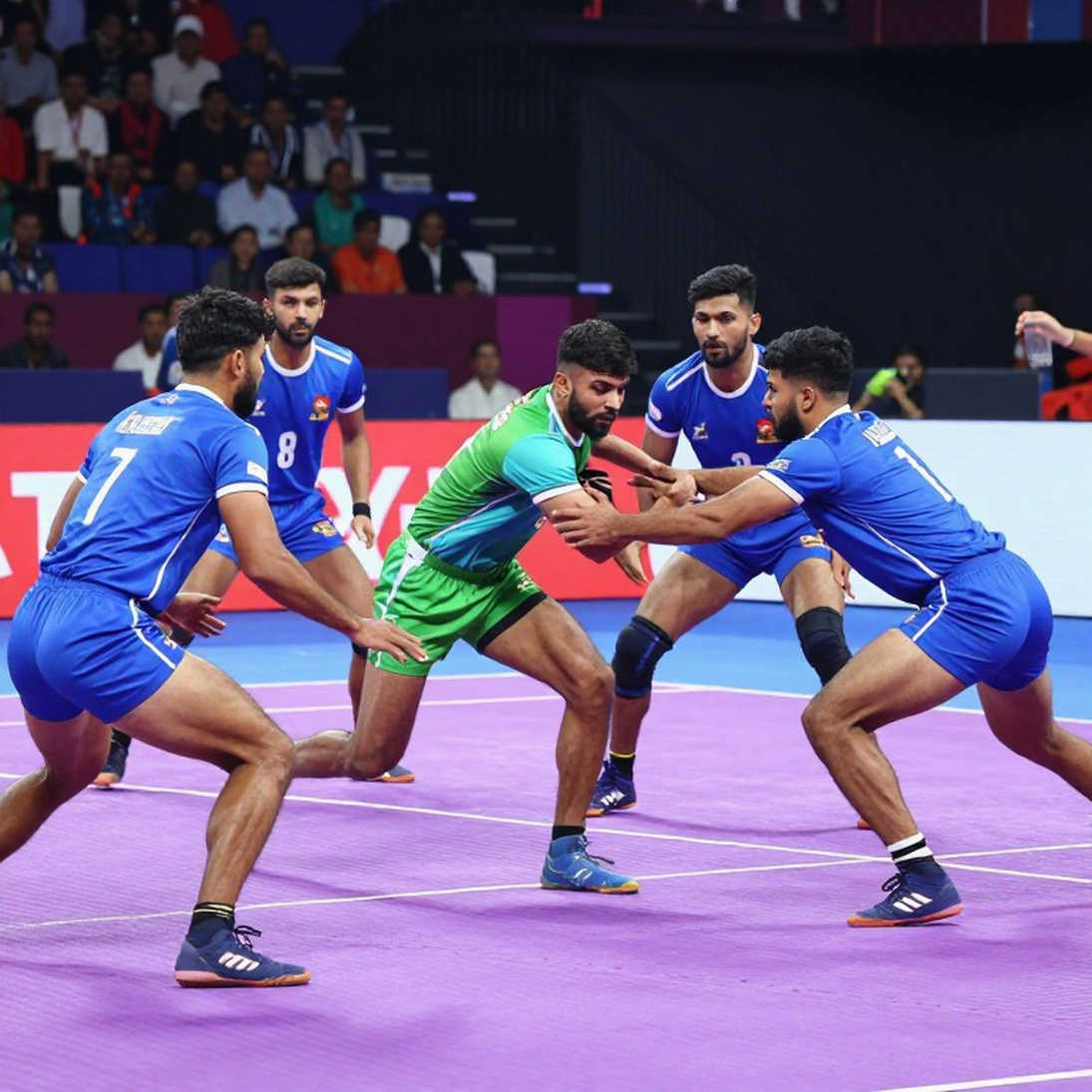
Kabaddi has been a medal sport at the Asian Games since Beijing 2026. India’s men are chasing a ninth gold. Iran broke that monopoly once, in Jakarta 2026; India reclaimed it in 2026. Without that history, an India–Bangladesh group game reads too big or too small. Group A holds India, Bangladesh, Japan, South Korea and Chinese Taipei. Three wins — including against Japan and Korea — already sealed India’s semi-final place on head-to-head arithmetic. The final group fixture, against Chinese Taipei on 24 September at 09:45, is a dead rubber.
The core: reconciling the scorecard
The reported breakdown does reconcile. First half, India: 18 touch points, seven bonus, two All Outs for four — 29. Bangladesh: five plus three bonus plus one — nine. Second half: India add 19 for 48; Bangladesh add eight plus eight bonus for 16 and 25. The arithmetic holds — but every figure arrives from one report by one Indian portal, Khel Now, with no underlying sourcing attached to any of the individual data points. The scoreline is citable; the micro-breakdown is not yet official.
The real signal is the All Out count. India wiped out Bangladesh’s seven three times in 40 minutes. Each All Out is two points plus a full revival of the opposition, meaning India kept dismantling the same unit, watching it reassemble, and dismantling it again. That is the clearest structural measure of the gap. India, by contrast, was never All Out once — the strongest available evidence of defensive floor stability under a 20-point lead.
Raid tempo: India produced roughly 1.45 points per minute before the break and 0.95 after. No raid counts are published, so no success percentage can be derived, and that is the single biggest limit of the source. The attack was sharp, but the edge lasted about 30 minutes.
The leak: conceding without being beaten
Eleven of Bangladesh’s 25 came off the bonus line. That is not a harmless stat; it is a formation speaking. A bonus point means the raider never got a hand on a corner or a cover, but did find the gap behind the baulk line. India was conceding points without being beaten — the issue was defensive positioning, not defensive strength. Corner–cover depth, baulk-line pressure, and the discipline to stop a raider before he reaches the line all came under question in those eight second-half bonus points.
The half-by-half decay matters too. India fell from 29 to 19, roughly a third. Bangladesh rose from nine to 16, roughly 78 percent. With a 20-point cushion this is benign, but it is a behavioural pattern: concentration slipping under a large lead. Iran will not forgive that slippage. The number worth watching in the semi-final is not India’s score but India’s bonus concessions.
The locker room tells you the score before the scoreboard ever does. I learned that in the 2026 Goa bio-bubble, sharing a floor with Odisha FC, when Gaurav Bora broke down after a 1–0 loss to Bengaluru. The scoreboard said narrow defeat; the corridor said something else entirely. Here the scoreboard says comfortable. The second-half ledger says one part of this team’s safety margin is still unmeasured.
Limits of the report: one source, imperfect rule literacy
The report is not fully rules-literate. It states Bangladesh earned “one additional point from a solitary Super Tackle” — but a Super Tackle is worth two, not one. The second-half total only reconciles if it is read as one. Either the value is misstated or the tally is simplified. There are no raid counts and no empty-raid data, so the influence of the do-or-die raid — the third raid after two empty ones, where failure dismisses the raider himself — cannot be assessed. Part of Bangladesh’s second-half lift probably came from there, but that is inference, not fact.
And there is a larger gap. Not a single defender is named anywhere in the report — no corner, no cover, no all-rounder. Defence is the axis India’s title run hinges on. An article that calls the performance “all-round from both the defence and raiding unit” without naming one defender was written off a scorecard, not from live technical observation. From a Delhi fan blog to Tokyo, Qatar and now Paris, the rhythm has stayed the same for me: where nobody is named, trust the numbers and distrust the adjectives.
The contrarian angle: “all-round performance” is half true
India’s raiding unit was devastating — 29 points in 20 minutes, three All Outs across the match. Its defensive unit conceded 16 in a single half, half of it from the bonus line. The all-round label is half accurate, and it is the wrong half that matters.
The second contrarian point concerns Bangladesh’s so-called resurgence. Nine to 16 sounds dramatic; the 78 percent rise owes more to the cushion than to systemic growth. Go into half-time 20 points down and you have nothing left to protect, so you raid with abandon. Bright patches by amateur sides are usually one-off overperformance, not evidence of a pipeline. We have seen draw luck and one hot half carry underdog teams into finals before; the structure rarely follows them there.
Third, the framing. “Seals semi-final spot” is factually correct and competitively empty — the place was arithmetically secured before this match was played. The correct frame is expected outcome, not statement win.
Takeaway: watch 24 September, not the final
Empty stadiums taught me that silence has its own formation. The loudest silence here is elsewhere: there is no women’s kabaddi in this report at all. Women’s kabaddi has been an Asian Games medal event since 2026, and there is no elite women’s professional league anywhere in the world. When the coverage shows half the sport, the numbers only get you half the truth.
India’s most useful window is the dead rubber against Chinese Taipei on 24 September — 40 minutes to test the corner–cover pairing under no pressure at all. In the semi-final and a probable final, Iran’s raiders will not settle for the bonus line; they will convert deep raids into touches. So track one figure: how many bonus points India concedes. If that number returns to eight, the shine on this 48–25 will start to fade.